

Making the decision to move into a retirement village is often about much more than property. It’s about lifestyle, security, health, family and planning for the future.
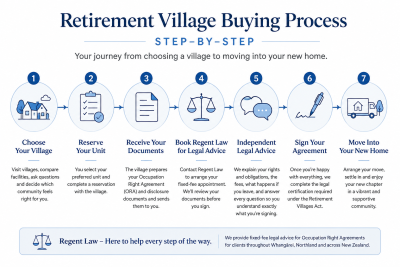
Once you’ve found the right village, you’ll usually be given an Occupation Right Agreement (ORA) to sign.
Most people are surprised by just how long these agreements are—and for good reason. They contain important legal and financial terms that can affect you or your family for years to come.
If you’re buying into a retirement village in Whangārei, Northland or anywhere in New Zealand, obtaining independent legal advice isn’t simply recommended—it’s a legal requirement before you can complete your purchase.
What is an Occupation Right Agreement?
Unlike buying a house, moving into a retirement village usually does not mean you own the unit.
Instead, you purchase the right to occupy it under an Occupation Right Agreement.
Every village has its own agreement, and while many contain similar concepts, the details can vary significantly.
These agreements commonly cover matters such as:
- your occupation rights
- weekly village fees
- deferred management fees
- refurbishment obligations
- what happens if you move into care
- what happens when your occupation ends
- how and when any money is repaid to you or your estate.
For many people, this is one of the largest financial decisions they will make in retirement.
Why do I need a lawyer?
The law requires you to receive independent legal advice before signing an Occupation Right Agreement.
Your lawyer’s role is much more than simply witnessing your signature.
At Regent Law, we:
- review the Occupation Right Agreement and disclosure documents
- explain the legal effect of the agreement in plain, practical terms
- identify any unusual or important clauses
- answer your questions
- make sure you understand your rights and obligations before you commit.
Our job isn’t to tell you whether you should move into the village—that’s a personal decision.
Instead, we help ensure you understand exactly what you’re signing.
Questions people often ask
“Will I get my money back?”
Usually, part of your capital is repaid when your occupation ends, but exactly how much and when depends on the terms of your agreement.
We’ll explain:
- how repayment works
- when repayment is likely to occur
- any deductions that apply
- how deferred management fees operate.
“What happens if I need hospital care?”
Every agreement deals with this slightly differently.
We’ll explain what happens if your health changes and how that may affect your occupation rights and financial position.
“Can my children inherit my unit?”
Generally speaking, your family does not inherit the unit itself.
Instead, your estate is usually entitled to receive the amount payable under the Occupation Right Agreement after your occupation ends.
We’ll explain exactly how this works under your agreement.
How long does the process take?
We recommend allowing around 2–3 weeks from the time the village sends us the documents.
This gives us enough time to:
- receive and review the documentation
- prepare your personalised advice
- meet with you
- answer your questions
- complete the signing process before your cooling-off period expires.
If you’re working to a tighter timeframe, let us know as early as possible and we’ll do our best to assist.
Occupation Right Agreement lawyers in Whangārei
Regent Law regularly advises clients entering retirement villages throughout Whangārei, Northland and across New Zealand.
We offer a fixed-fee service which includes the advice right through to completion of settlement.
Our aim is simple:
We want you to leave your appointment feeling confident that you understand your agreement—not overwhelmed by legal jargon.
Thinking about moving into a retirement village?
If you’ve chosen your village and are ready for independent legal advice on your Occupation Right Agreement, we’d be pleased to help.
Contact Regent Law to arrange your fixed-fee appointment and receive independent legal advice before signing.




Leave A Comment