

One of the most common questions we hear from clients considering a retirement village is:
“What is a deferred management fee, and how does it work?”
It’s an excellent question.
Deferred management fees (sometimes called DMFs or an exit fee) are a common feature of Occupation Right Agreements in New Zealand retirement villages. While the concept is relatively straightforward, every village calculates these fees differently, making it important to understand exactly how they will apply to you.
At Regent Law, we regularly provide independent legal advice on Occupation Right Agreements for clients throughout Whangārei, Northland and across New Zealand. One of the key things we do is explain how deferred management fees work under your particular agreement.
What is a deferred management fee?
A deferred management fee is a fee charged by the retirement village in return for the services, facilities and long-term management of the village.
Rather than paying the full fee upfront, it is usually deducted later, when your Occupation Right Agreement comes to an end.
In most cases, that will be when:
- you permanently leave the village
- you move into a higher level of care (depending on the agreement)
- your estate brings your occupation to an end after your death.
The fee is usually deducted from the amount payable to you or your estate when the agreement ends.
Why do retirement villages charge deferred management fees?
Deferred management fees help fund the ongoing operation of the village.
They contribute towards matters such as:
- maintaining village facilities
- managing the village community
- long-term upkeep and administration
- providing shared amenities and services.
Because retirement villages operate under a different financial model from traditional home ownership, deferred management fees are a standard feature of most Occupation Right Agreements.
How much is the deferred management fee?
There isn’t one standard percentage across all retirement villages.
Different villages—and sometimes different agreements within the same village—may calculate deferred management fees in different ways.
For example, agreements may differ in:
- the maximum fee that can apply
- how quickly the fee accrues
- whether it reaches a cap after a number of years
- what amount the percentage is calculated against.
This is one of the reasons independent legal advice is so valuable. Rather than relying on general information, you’ll understand exactly how the fee operates under your Occupation Right Agreement.
Does a deferred management fee mean I’ve “lost” my money?
This is one of the biggest misconceptions we encounter.
A deferred management fee is simply one part of the financial arrangement you agree to when entering the retirement village.
Like any significant financial decision, it’s important to understand the overall picture rather than focusing on a single number.
When considering a retirement village, it’s helpful to weigh up factors such as:
- lifestyle benefits
- maintenance-free living
- security
- community
- future support
- ongoing costs
- how the repayment provisions work when your occupation ends.
Every person’s priorities are different, and what represents good value for one person may differ for another.
What else should I consider?
The deferred management fee is only one aspect of the Occupation Right Agreement.
It’s also important to understand:
- weekly village fees
- what happens when you leave the village
- when repayment is made
- whether refurbishment costs apply
- what happens if your health changes
- what your family can expect after your death.
Looking at these issues together gives you a much clearer understanding of the agreement as a whole.
How Regent Law can help
Our role isn’t to tell you whether a retirement village is right for you.
Instead, we help you understand exactly what you’re signing.
When we review your Occupation Right Agreement, we’ll explain:
- how your deferred management fee is calculated
- when it becomes payable
- whether there is a cap
- how it fits into the overall financial arrangements
- any other provisions you should be aware of.
We’ll answer your questions in straightforward language so you can make an informed decision with confidence.
Looking for Occupation Right Agreement legal advice?
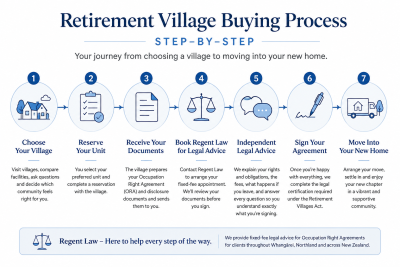
Regent Law provides fixed-fee legal advice on Occupation Right Agreements for clients throughout Whangārei, Northland and across New Zealand.
If you’ve received your retirement village documents, we’d be pleased to help you understand the legal and financial implications before you sign.
Click here to arrange your fixed-fee appointment and receive independent legal advice tailored to your Occupation Right Agreement.
Disclaimer: Every retirement village is different.
Deferred management fees can vary significantly between Occupation Right Agreements. This article provides general information only and should not be relied upon as legal advice. We can explain exactly how the deferred management fee operates under your specific agreement before you sign.




Leave A Comment