

Moving into a retirement village is an exciting milestone. For many people, it’s the start of a simpler lifestyle, greater peace of mind, and the opportunity to enjoy a supportive community without the responsibilities of maintaining a large home.
Before you sign an Occupation Right Agreement (ORA), however, it’s worth taking the time to understand exactly what you’re agreeing to.
An Occupation Right Agreement is a significant legal document that sets out your rights, obligations and financial arrangements with the retirement village. Every village has its own agreement, and while many contain similar concepts, the details can differ in important ways.
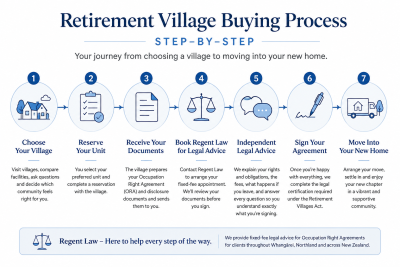
At Regent Law, we regularly provide fixed-fee Occupation Right Agreement legal advice for clients in Whangārei, Northland and throughout New Zealand. Here are seven questions we encourage every prospective resident to ask before signing.
1. What exactly am I buying?
One of the biggest misconceptions about retirement villages is that you’re purchasing the unit itself.
In most cases, you are not buying real estate in the traditional sense. Instead, you are purchasing the right to occupy a unit under an Occupation Right Agreement.
This distinction affects your legal rights, how the agreement ends, and what happens to your investment when you leave the village.
Understanding this from the outset makes it much easier to understand the rest of the agreement.
2. What fees will I pay now and in the future?
The entry payment is only one part of the financial picture.
Your Occupation Right Agreement may also deal with matters such as:
- Weekly village fees.
- Deferred management fees.
- Refurbishment or reinstatement costs.
- Charges for optional services.
- Ongoing responsibilities while you occupy the unit.
It’s important to understand not only what you’ll pay today, but also what costs may arise over the years.
3. What happens if I decide to leave?
Life doesn’t always go according to plan.
You may decide to move closer to family, require a higher level of care, or simply decide that village living is no longer right for you.
Before signing, it’s important to understand:
- How your occupation ends.
- When your repayment becomes payable.
- What deductions may apply.
- Whether repayment depends on the unit being relicensed.
- How long repayment may take.
These arrangements vary between villages, making independent legal advice particularly valuable.
4. What happens if my health changes?
Many people enter a retirement village while they are active and independent.
Your agreement should also explain what may happen if your circumstances change.
Questions to consider include:
- Can you remain in your unit?
- When might you need to move into care?
- How could that affect your financial position?
- What options are available if your needs change over time?
Understanding these provisions now can provide reassurance for both you and your family.
5. What happens after I pass away?
Many clients are understandably concerned about making things as straightforward as possible for their loved ones.
Your lawyer can explain:
- What happens to your Occupation Right Agreement.
- How your estate receives any money payable.
- What your executor will need to do.
- The likely process and timeframes involved.
Having a clear understanding now can make things much easier for your family later.
6. Can I change my mind?
The law provides a cooling-off period after signing an Occupation Right Agreement.
However, once that period has expired, leaving the agreement may have financial consequences.
It’s important to understand:
- How long the cooling-off period lasts.
- When it begins.
- What happens if your circumstances change after that.
Knowing your options before you sign allows you to make your decision with confidence.
7. Have I received independent legal advice?
This is arguably the most important question of all.
Independent legal advice is a legal requirement before an Occupation Right Agreement can be completed.
At Regent Law, our role is not to persuade you whether or not to move into a retirement village. That decision is yours.
Our role is to ensure you understand exactly what you’re signing.
We’ll review your Occupation Right Agreement, explain the legal and practical implications in straightforward language, answer your questions, and make sure you feel informed before you commit.
Why choose Regent Law for Occupation Right Agreement advice?
Choosing a retirement village is a major life decision. Choosing the right lawyer should feel straightforward.
Regent Law provides fixed-fee Occupation Right Agreement legal advice for clients throughout Whangārei, Northland and across New Zealand.
We understand that many people have already chosen their preferred village by the time they come to us. Our focus is on helping you understand the agreement, the financial arrangements, and the legal implications, so you can proceed with confidence.
Our clients value practical advice, clear explanations and a personal approach. We take the time to answer your questions without overwhelming you with legal jargon.
Need independent legal advice before signing?
If you’ve received an Occupation Right Agreement from a retirement village, we’d be pleased to help.
Click here to arrange your fixed-fee appointment. We’ll review your documents, explain everything you need to know, and ensure you can sign with confidence.
If you’re looking for an Occupation Right Agreement lawyer in Whangārei or Northland, Regent Law is here to help.




Leave A Comment